


We Built a Partner Program Before We Built a Sales Team
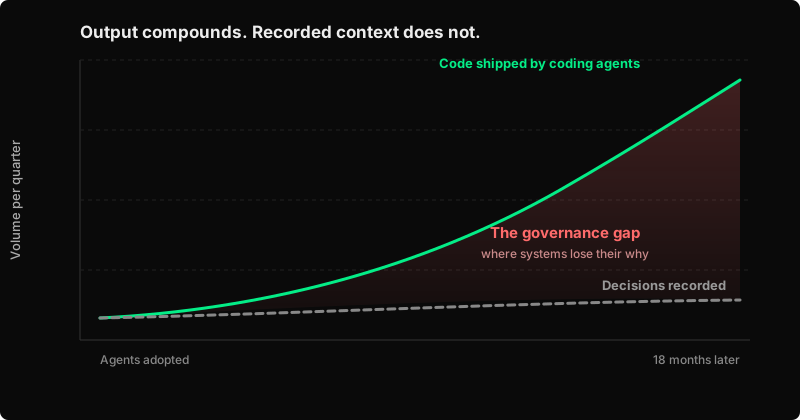
Coding agents now ship code faster than teams record the decisions behind it. The first teams to feel the strain are not the ones moving slowest, they are the ones moving fastest. When agents are generating code across large repos and large teams, something starts to break that is hard to name. The agents burn more tokens and need more human steering just to stay oriented in a codebase they did not build, and the architectural decisions that used to live with your senior engineers start disappearing into the noise. The pattern is almost always the same: the code ships, the decision does not get recorded, and six months later nobody knows why the system was built the way it was, right as the next agent is about to make it worse.
We call this the architectural governance gap, and it is not theoretical. Every agency and consultancy we have talked to over the last twelve months has described a version of it, in their own projects or in their clients'. The vocabulary differs; the problem is the same. Code output is compounding while recorded decisions stay flat, and the space between those two lines is real cost: development slows, token spend climbs, and agents burn context re-deriving decisions nobody wrote down. Actual AI exists to close that gap: our platform turns Architecture Decision Records from documentation into live guardrails, enforced in real time as agent-generated code ships.
Why a partner program before a sales team
Not because we did not want to sell. The problem is easy to see: teams running agents without ADRs are burning tokens and producing slop, and the fix is easy to show, because an agent addressing the same request with ADRs in context burns fewer tokens and ships cleaner code. What we needed was reach. The consultancies, system integrators, and platform teams doing AI-native delivery for clients right now are the ones positioned to take that performance improvement to customers at scale. Those are the people we wanted in the room first, as practitioners who use Actual AI internally, see what changes, and bring the results to clients. In a technical community, authentic advocacy is the only kind that works. Our founding cohort are firms who saw the governance gap before we explained it to them, and that matters more than anything we could have scripted.
Meet the founding cohort
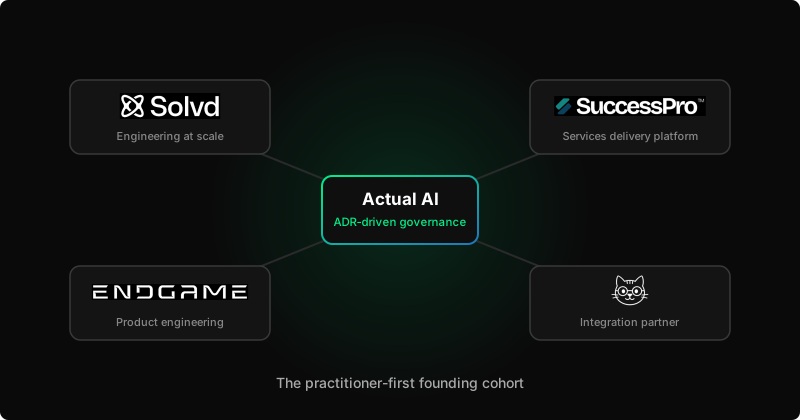
Four service partners and one integration angle, each a distinct take on the governance problem. Full profiles live on the partners page.
- Solvd is an AI engineering company built around the last mile: as their homepage puts it, "80% of the way is easy. The last 20% is where it all breaks." Seven hundred plus engineers, 150+ AI and ML specialists, and three practices (Core AI, AI Data and Cloud, and Agentic Software Engineering) serving clients like Reddit, NASDAQ, and The Washington Post. As their clients accelerate, architectural coherence becomes the bottleneck, and the question shifts from "how do we go faster" to "how do we go faster safely."
- SuccessPro is a unified AI platform for projects, people, and financials, built for technology services companies. Their published outcomes: 5 to 10% margin lift, 30% higher utilization, and financial closes that land 7 days faster. Their whole thesis is that AI should be built in, not bolted on, and Actual AI integrates into that workflow ecosystem so faster code generation doesn't create faster technical debt.
- ENDGAME is built differently: senior specialists who all build, no project managers managing project managers, and lean teams embedded directly with clients, delivering 2.2x faster time-to-market for clients like IKEA, Nike, and Philips. Their clients aren't experimenting with AI transformation, they're in it. Actual AI becomes the connective tissue between legacy and AI-native architectures, documenting the why behind transformation decisions while enforcing guardrails during migration.
- Spec Kitty, our first integration partner, is an open-source delivery control plane for teams building with coding agents. When engineering runs on Claude Code, Codex, Cursor, Copilot, or Gemini, work fragments across terminals, tickets, branches, and chat. Spec Kitty runs an intent-to-merge pipeline (spec, plan, tasks, review, accept, merge) that captures every work package and acceptance decision in the repo itself, a bright software factory instead of a black box. Spec Kitty structures the what and when of agentic workflows; Actual AI structures the why and how. Specification-driven development meets ADR-driven governance.




Why firms are building governance practices right now
- A new revenue stream is forming. AI governance is becoming a billable practice area: governance audits, ADR implementation services, architectural review inside ongoing retainers. Clients are starting to ask for these. The firms that build the capability now will capture that revenue in the next 12 to 18 months.
- Competitive differentiation is real and time-limited. "AI governance practice" is a positioning statement that works today. In two years it will be table stakes. The firms that build internal capability, document the results, and publish the methodology now will own the category framing. The ones who wait will be explaining why they're catching up.
- Client engagements get stickier. When your firm maintains architectural integrity across a client's AI development workflow, you are not a project vendor anymore. You are infrastructure. That changes the renewal conversation entirely.
- Portfolio leverage is structural, not linear. For firms with portfolio exposure, one governance practice deployed internally scales across every portfolio company.
What partnership looks like
We work with three types of partners, and the commercial structure fits the model.
- Referral partners introduce Actual AI to clients navigating the governance gap. Leads are registered, protected, and compensated.
- Reseller partners bundle Actual AI into their delivery methodology, as part of an AI-native engagement model or as a standalone governance layer for client teams.
- Integration partners connect at the tooling level, complementing the agentic development workflow with our governance layer at the right moment in the cycle.
All three start the same way: use it internally first. Build a practice on Actual AI, document what changes, and we support the deployment, co-market the results, and protect your pipeline.
This is the founding cohort, not the final one
Over the next few months we are publishing a spotlight on each partner, the problems they are solving and what building a governance practice actually looks like, here on the blog. The firms that build the governance capability now will define what AI-ready delivery looks like for the wave of clients behind them. If that is a practice you want to build, start at actual.ai/partners or get in touch.