


The Enterprise Software Factory: Why AI Is Changing More Than How We Write Code
"We gave everyone AI coding assistants. Why doesn't engineering feel 10x faster?"
Over the past year, I've heard versions of this question from engineering leaders across startups and large enterprises alike.
The expectation seemed reasonable. AI coding assistants can generate code in seconds, explain unfamiliar codebases, write tests, and even implement entire features. If every developer suddenly becomes more productive, shouldn't the entire engineering organization move faster?
In practice, many organizations have discovered something surprising.
Developers are writing code faster than ever, yet product roadmaps still slip. Pull requests continue to pile up. Architectural inconsistencies become more common. Platform teams struggle to keep standards aligned. Security and compliance reviews remain bottlenecks. Engineering leaders still spend hours every week trying to understand project status across dozens of teams.
The bottleneck was never simply writing code.
It was coordinating everything around it.
That realization is leading many organizations toward a new operating model—one that several industry leaders have begun calling the software factory.
We've Optimized the Developer. Now We Need to Optimize the Organization.
For nearly two decades, engineering organizations have invested heavily in developer productivity.
We built better IDEs. We automated testing. We adopted cloud infrastructure, CI/CD pipelines, feature flags, infrastructure as code, and platform engineering. Each innovation reduced friction for individual developers and helped teams ship software more efficiently.
AI coding assistants represent the next logical step in that evolution. They reduce the time required to implement code, understand unfamiliar APIs, generate tests, and complete repetitive engineering tasks.
Those gains are real, and they are significant.
But they also expose a new reality: writing code is only one part of delivering software.
An engineer may complete a feature in half the time, but the work still needs to move through architecture reviews, security validation, integration testing, deployment pipelines, release approvals, and operational monitoring. Product managers still need to define requirements. Platform teams still need to maintain standards. Engineering leaders still need visibility into hundreds of concurrent initiatives.
Improving one stage of the process doesn't automatically improve the entire system.
This is a lesson manufacturing learned decades ago. Increasing the speed of one assembly station doesn't double factory output if every downstream station becomes congested. The throughput of the entire factory is determined by the system, not by its fastest worker.
Software engineering is beginning to experience the same phenomenon.
AI Is Accelerating Complexity
There's another challenge that enterprise organizations are beginning to encounter.
As AI makes implementation easier, it also becomes easier to create inconsistency.
Imagine an enterprise with 3,000 engineers spread across dozens of product organizations.
One team uses Cursor.
Another uses Claude Code.
A third builds internal AI agents.
Each team develops its own prompts, coding conventions, documentation habits, and review processes. New services are created faster than architects can review them. Documentation quickly falls behind implementation. Engineers spend increasing amounts of time understanding AI-generated code they didn't write.
The result isn't necessarily higher quality software.
It's simply more software.
For enterprise leaders, this creates a new question.
How do you scale AI without losing consistency?
That question is fundamentally different from asking which coding model is best.
It shifts the conversation away from individual developer tools and toward organizational systems.
Enter the Software Factory
The term software factory can be misleading.
Many people hear it and imagine a more capable coding agent that can autonomously build applications from start to finish.
In reality, a software factory is much broader than that.
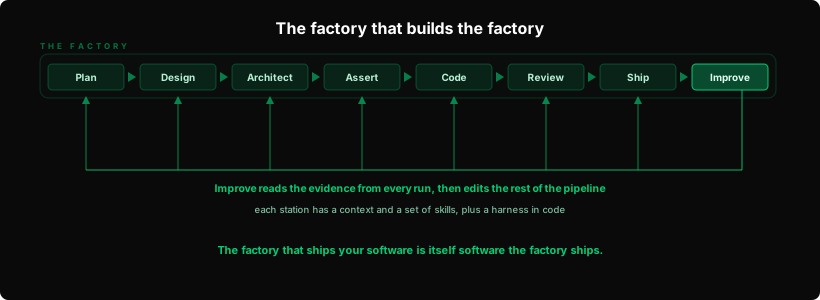
A software factory is the system that transforms ideas into production software.
It encompasses planning, architecture, implementation, testing, governance, deployment, measurement, and continuous improvement. AI agents are an important part of that system, but they are only one component.
Consider how modern manufacturing evolved.
Factories didn't become more productive simply because machines became faster. They became more productive because organizations standardized processes, documented best practices, automated quality assurance, and continuously optimized the entire production system.
Software engineering is following a remarkably similar path.
The organizations that succeed won't simply deploy more AI tools. They'll build systems that enable humans and AI to work together consistently, securely, and at enterprise scale.
The Competitive Advantage Is Shifting
For years, engineering organizations competed by hiring exceptional developers.
Tomorrow, they'll compete by building exceptional engineering systems.
Every company has access to increasingly capable AI models. Over time, the capabilities of those models will continue to converge.
What won't converge is organizational knowledge.
Your architecture.
Your engineering standards.
Your security requirements.
Your product decisions.
Your operational experience.
These are the assets that differentiate one engineering organization from another.
The companies that can capture this knowledge, make it accessible, and apply it consistently across thousands of engineers and AI agents will deliver software more predictably than organizations relying on tribal knowledge and disconnected tooling.
In other words, the competitive advantage shifts from individual productivity to organizational capability.
This Is Why Enterprise Software Factories Matter
The software factory isn't another AI coding tool.
It's the operating model that allows enterprises to adopt AI responsibly and at scale.
It recognizes that implementation is becoming increasingly automated while coordination, governance, and organizational knowledge become increasingly valuable.
The question for engineering leaders is no longer whether AI should be part of software development.
That question has already been answered.
The more important question is whether your organization is prepared to manage software development when both humans and AI agents are contributing at unprecedented speed.
The organizations that answer that question well will build software faster, maintain higher quality, and adapt more quickly than their competitors.
The organizations that don't may find themselves producing more code than ever before, but with less visibility, less consistency, and more operational risk.
The future belongs not to the organizations with the fastest coding assistants.
It belongs to the organizations with the best software factories.
Software Factory Playbook #1: Inventory Before You Invest
Many enterprises respond to AI by purchasing additional developer tools. Before expanding your AI stack, take a step back and understand your current state.
Ask yourself:
- Which AI coding tools are already being used across engineering teams?
- Do different business units follow different architectural standards?
- Is engineering knowledge centralized or scattered across documents, wikis, Slack, and individual experts?
- Can you measure how AI is impacting engineering throughput, quality, or cycle time?
- Who is responsible for governing AI-assisted development?
You may discover that your biggest opportunity isn't introducing another coding assistant—it's building the organizational foundation that allows AI to scale successfully.
In Part 2 of this series, we'll move from why software factories matter to how enterprises can build one. We'll break down the core layers of an enterprise software factory, from knowledge management and planning to AI orchestration, governance, and continuous measurement, and discuss practical steps engineering leaders can take to begin the journey.