


A Software Factory Is Good Engineering, and Slop Is What Happens Without It
Dex Horthy, a co-founder of HumanLayer and now at Factory, gave a talk at AI Engineer called 12 Rules for a Software Factory That Doesn't Ship Slop. His argument is that a software factory is good engineering with agents doing the building. Four of his points bear directly on the work we do with architectural decisions.
1. Models on their own do not maintain a codebase
Dex cited SlopCodeBench, a benchmark from researchers at the University of Wisconsin-Madison. Most coding benchmarks give a model one complete problem. SlopCodeBench gives the specification in stages, and at each stage the model has to extend the code it wrote for the stage before. Dex reported that the best model scores about 16%. An engineer who builds by hand notices a bad abstraction and fixes it. An unattended agent does not.
If the codebase has to last, the decisions about how it is built need to persist. The agent will not store them reliably or consistently on its own.
2. Slop compounds
The manifesto Dex launched in the talk defines slop as work that took less effort to produce than the reader has to spend to understand it. The more slop sits in the code, the documents and the chat history, the more of it the next agent reads and copies. An agent treats the existing code as the standard.
That makes the existing code a poor source of rules. A decision has to be written down and has to outrank whatever the agent finds in the repository.
3. Verification cannot be bought
Dex said a team can buy most of a factory: virtual machines to run the agents, a harness and a control plane. What a team cannot buy is verification, because only the team knows how its code should work.
We agree. The opinions belong to the team. Writing them down, keeping them current and checking every change against them is engineering work, and most teams have not done it.
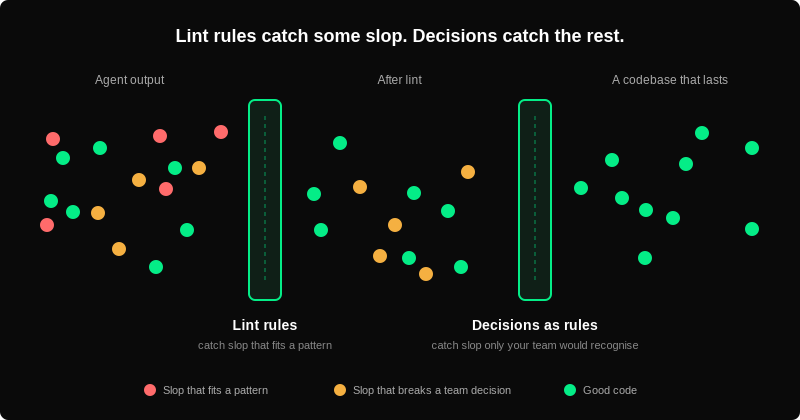
Lint rules are part of that work. The talk recommends rule sets written against the habits of coding agents, such as anti-slop for TypeScript. Lint rules catch the slop that can be written as a pattern. The rest has to be described in plain language, so that people and agents agree on what else counts as slop.
4. Decisions need their own home
Dex asked teams to unify the forge. A forge is the platform where a team keeps and reviews its code, such as GitHub or GitLab. His point is that the forge centralised the code and nothing else. Designs and decisions still sit in documents and chat threads.
We agree that chat threads and documents are the wrong place for decisions. We do not think the answer is another folder in the repository. A decision is proposed, approved by an engineer, scoped to part of the codebase and retired when it stops being true. That work justifies a dedicated interface, with plugins that deliver the right decisions to coding agents and software factories at planning, implementation and review.
What we take from it
The talk closed with the Anti-Slop Manifesto, published as No AI Slop: A Manifesto. We signed it. Two of its resolutions matter most to us. The first says that when a mistake shows up twice, the team should improve the system and its guardrails. The second says that agent reviewers, linters and verifiers are useful but not sufficient, so a person still reviews some subset of the output.
Our answer to both is the same. When a mistake shows up twice, record the decision that would have prevented it as a rule and check every later change against that rule. The subset a person reviews is the rules, because an engineer approves each one before it is enforced. A person cannot read every pull request. A person can read every rule.
Actual AI builds an architecture agent that works beside a software factory, not inside it. It discovers the architectural decisions in your codebase, puts them in front of an engineer for review, filters the rules for each task and enforces them on every pull request.